+86-19862000127


Choosing among China’s top lifting pulley manufacturers requires more than comparing prices or attractive product photographs. A reliable supplier should demonstrate practical production experience, consistent quality control, and clear technical knowledge. This article examines manufacturers that produce lifting pulleys for workshops, warehouses, construction sites, marine applications, and industrial maintenance.
The comparison focuses on material selection, sheave design, bearing performance, rope compatibility, rated capacity, and surface protection. Factory audits can reveal details that catalogs often omit. Look for documented load testing, traceable raw materials, dimensional inspection, and careful packaging. Certificates may support credibility, but they should match the actual product and intended application. Claims need proof.
A strong manufacturer should explain how its lifting pulley performs under repeated loading, dusty environments, moisture, and uneven operating conditions. It should also provide drawings, inspection records, replacement parts, and responsive technical support. These details matter. In real use, a poorly aligned sheave or rough bearing can increase rope wear and create avoidable downtime. However, “top” does not always mean the largest exporter or the cheapest factory. The best choice depends on your lifting requirements, order volume, customization needs, and risk tolerance. Some supplier information may remain incomplete, so independent verification is still necessary. This guide offers a practical framework for evaluating leading Chinese manufacturers without treating marketing language as final evidence.
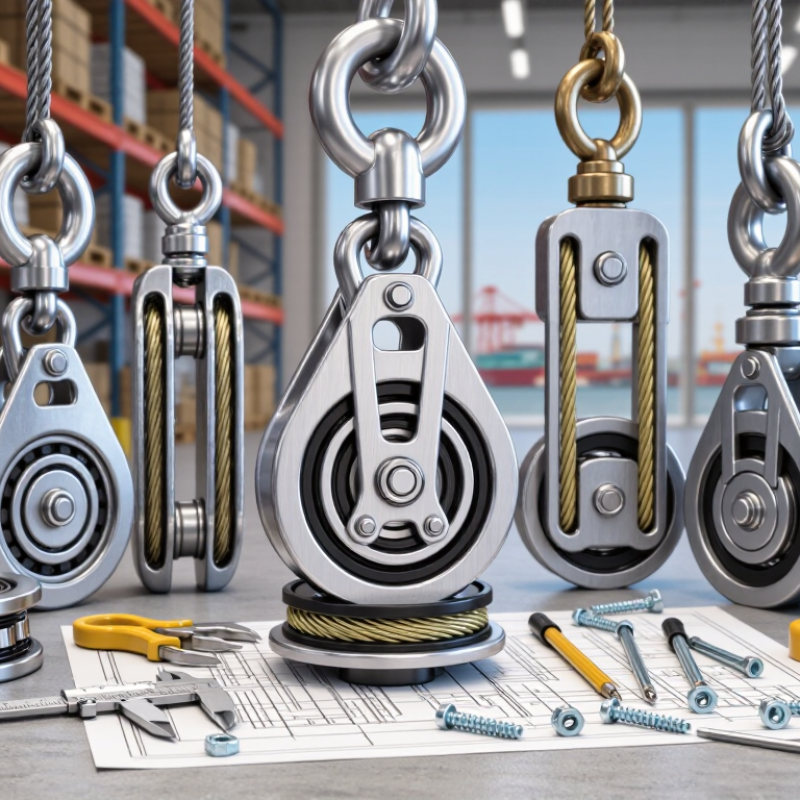
Lifting pulleys are mechanical devices that redirect rope or cable and reduce the force needed to raise a load. A fixed pulley changes pulling direction. A movable pulley shares part of the load. Multiple pulleys form a block and tackle system for heavier lifting. In a workshop, the wheel may sit inside a steel frame, while a grooved sheave guides the rope. The groove matters. A poor match can cause slipping, uneven wear, or sudden rope damage. Operators should check rated capacity, sheave diameter, bearing movement, hook condition, and frame distortion before use. These details reflect practical inspection, not just catalog claims.
When comparing China lifting pulley manufacturers, buyers should request test records, material information, dimensional drawings, and clear capacity ratings. Reliable producers should explain whether the pulley suits wire rope, synthetic rope, hand operation, or powered equipment. Factory quality systems help, but traceable inspection remains important. I would not rely on appearance alone. A polished pulley can still contain poor bearings or inaccurate machining. Site conditions also matter, including dust, moisture, temperature, and lifting frequency.
Tips: Keep the rope centered in the groove. Never exceed the marked working load. Lubricate only where the manufacturer permits it. Stop using a pulley after cracks, harsh noise, or stiff rotation appear. A small inspection mistake can become a serious lifting failure.

Ideal mechanical advantage of common lifting pulley configurations. A higher value indicates greater lifting assistance, while real-world performance is reduced by friction, rope weight, and equipment losses.
A fixed pulley mainly changes the direction of the pulling force and has an ideal mechanical advantage of 1. A movable pulley can theoretically halve the required lifting force, while block-and-tackle systems provide greater mechanical advantage according to the number of rope sections supporting the load. Always select lifting equipment according to its rated load capacity and applicable safety standards.
Choosing among China’s lifting pulley manufacturers requires more than comparing prices. A reliable evaluation begins with product evidence, not attractive catalog photos. Check rated load, rope compatibility, sheave diameter, bearing quality, and frame thickness. Ask for material certificates and documented load-test results. A professional manufacturer should explain how each pulley is inspected before shipment.
Factory experience also matters. Request production photos, inspection records, and sample measurements from recent orders. Look for consistent machining, smooth rotation, secure fasteners, and clean welds. Traceable batch numbers can make quality problems easier to investigate. Communication is another practical test. Technical answers should be specific, timely, and supported by drawings or data. Vague promises deserve caution. My own evaluation would include a sample order, although even samples cannot reveal every long-term issue.
Tips: Compare at least three suppliers using the same questions. Confirm testing standards for your destination market. Review packaging, spare-part availability, lead times, and warranty terms. A factory audit can reveal storage problems or rushed assembly. Do not rely on certificates alone. Verify the issuing organization and match the certificate to the actual pulley model. Small details matter. Also, leave room for uncertainty; published capacity may change under poor alignment, shock loading, or outdoor exposure. A lower quote can become expensive when replacement delays, inconsistent dimensions, or weak technical support appear later.
| Evaluation Dimension | Recommended Benchmark | Evidence to Request | Why It Matters | Suggested Score |
|---|---|---|---|---|
| Product Classification | Clearly defined manual, electric, fixed, swivel, snatch, or wire-rope pulley range | Product catalogue, technical drawings, application guide | Confirms that the manufacturer has relevant design and production experience | 0–5 |
| Rated Load Capacity | Rated working load, rope diameter, and lifting configuration stated for every model | Load chart, nameplate sample, calculation sheet | Prevents selection based only on maximum or nominal capacity | 0–5 |
| Safety Factor and Design Margin | Design safety factor and its calculation basis disclosed for load-bearing parts | Design calculations, inspection records, applicable standard references | Shows how the product is designed for repeated and dynamic loading | 0–5 |
| Materials and Heat Treatment | Material grades, hardness requirements, and corrosion-protection process documented | Material certificates, heat-treatment records, coating specifications | Material quality affects strength, wear resistance, and service life | 0–5 |
| Sheave and Bearing Performance | Sheave groove dimensions match the specified rope; bearings are protected and serviceable | Dimensional inspection report, bearing specification, lubrication instructions | Correct alignment reduces rope wear, friction, and operating risk | 0–5 |
| Testing and Inspection | Routine dimensional, functional, and load-related inspections completed before shipment | Factory acceptance test, inspection plan, sample test report | Independent evidence is more reliable than catalogue statements | 0–5 |
| Quality Management | Documented incoming-material, in-process, and final-inspection procedures | Quality manual, process flow, nonconformity records, audit results | Consistent processes help reduce batch-to-batch variation | 0–5 |
| Standards and Certification | Compliance requirements identified according to destination market and application | Valid certificates, declarations, standard references, third-party reports | Certification must match the product, model, and intended market | 0–5 |
| Customization Capability | Ability to modify dimensions, mounting arrangement, finish, packaging, or documentation | Engineering drawings, prototype process, change-control procedure | Useful when standard pulleys do not match the equipment or installation | 0–5 |
| Traceability | Serial, batch, or production records link the finished pulley to materials and inspections | Traceability procedure, batch record, product identification sample | Supports recalls, warranty claims, and maintenance investigations | 0–5 |
| Production Capacity | Available machining, forging, casting, assembly, and surface-treatment resources match order needs | Factory profile, equipment list, production schedule, capacity statement | Capacity affects delivery reliability and repeat-order consistency | 0–5 |
| Lead Time and Minimum Order Quantity | Written quotation separates sample, production, and shipping lead times | Quotation, production schedule, MOQ policy, packaging details | Clear commercial terms make total procurement cost and timing predictable | 0–5 |
| Export and Documentation Support | Provides accurate commercial, technical, packing, and customs documentation | Sample invoice, packing list, certificate package, installation manual | Complete documentation reduces customs and installation delays | 0–5 |
| After-Sales Service | Written warranty, spare-parts policy, technical support, and complaint-response process | Warranty terms, service contacts, spare-parts list, corrective-action example | Service quality influences downtime and long-term ownership cost | 0–5 |
| Total Evaluation Score | Maximum: 70 points | |||
Which China Lifting Pulley Manufacturers Stand Out?
China lifting pulley manufacturers stand out when their products perform consistently beyond a polished catalog. Experienced suppliers usually explain groove design, sheave material, bearing selection, and safe working load clearly. They do not hide behind vague phrases such as “heavy duty.”
A reliable factory should provide load-test records, material certificates, dimensional drawings, and traceable batch numbers. Factory visits can reveal useful details: organized assembly lines, calibrated testing equipment, protected storage, and workers checking shaft alignment. These small signs often matter more than attractive packaging. That matters.
Manufacturers with strong engineering teams can adapt pulley diameter, hook style, rope compatibility, and surface treatment for different lifting systems. They should also understand relevant international safety requirements and explain where their design has limits. Clear answers build trust. Delayed answers do not.
However, supplier evaluation is rarely perfect. A detailed inspection may still miss inconsistent subcontracted parts or rushed final assembly. I would request recent inspection samples, not only old certificates. I would also compare repeated test results across several batches. A low quotation can be useful, but it may reflect thinner components or weaker after-sales support. Careful buyers should examine warranty terms, replacement-part availability, packaging strength, and delivery records before approving a long-term order.
When comparing China lifting pulley manufacturers, quality begins with engineering evidence, not polished product photos. Experienced buyers should request load ratings, material certificates, dimensional drawings, and proof-test records. A reliable pulley should track smoothly under load, with no sharp rope contact or unusual bearing noise. Small details matter. Groove geometry affects rope life, while sealed bearings reduce contamination in dusty workshops. Protective coatings also deserve inspection, especially for humid ports or outdoor construction sites.
Service quality separates capable manufacturers from low-cost suppliers. Strong teams answer technical questions clearly and provide drawings before production. They should explain inspection points, packaging methods, spare-part availability, and realistic delivery times. Ask whether each unit carries a traceable batch number. This supports maintenance records and helps identify problems quickly. Factory audits, sample testing, and independent inspection can reveal more than a sales conversation. Communication speed matters, but accurate communication matters more.
My own evaluations are not flawless. A smooth sample can hide weak consistency across a larger shipment. Therefore, compare several production batches when possible. Check welds, machining tolerance, surface finish, and test documentation together. Some suppliers offer fast replies but vague corrective actions. That is a warning sign. Others may admit a design limitation and suggest a safer rating. That honesty has practical value. Before purchase, agree on acceptance criteria, inspection timing, warranty duties, and after-sales response channels in writing.
When comparing China lifting pulley manufacturers, buyers should inspect evidence, not polished catalogs. The ILO estimates 2.93 million workers die from work-related causes yearly, with 395 million nonfatal injuries. This makes traceable safety testing essential, even for a small pulley.
Request the working load limit, proof-test results, material certificates, and batch records. Check whether designs follow relevant standards, such as EN 13157 or ASME B30.26, where applicable. A credible factory should explain rope compatibility, bearing protection, corrosion treatment, and fatigue testing in plain language.
Ask to witness a load test. A photograph is not enough.
Audit the production floor, especially machining, heat treatment, assembly, and final inspection. The ISO Survey reports more than 1.2 million ISO 9001 certificates worldwide, but certification alone does not prove pulley quality. Verify the certificate’s scope and issuing body.
Review failure rates, replacement procedures, and response times for technical questions. One overlooked detail matters:
Many quotations leave this unclear. Buyers should also test samples under realistic conditions, including dust, moisture, repeated loading, and uneven rope entry. Some manufacturers may resist independent inspection. That hesitation deserves reflection.